String of Hearts: Light Is What Keeps It Full
String of hearts (Ceropegia woodii) care: bright light, semi-succulent watering, soil, super easy propagation and why it gets leggy. Full guide.
In this article
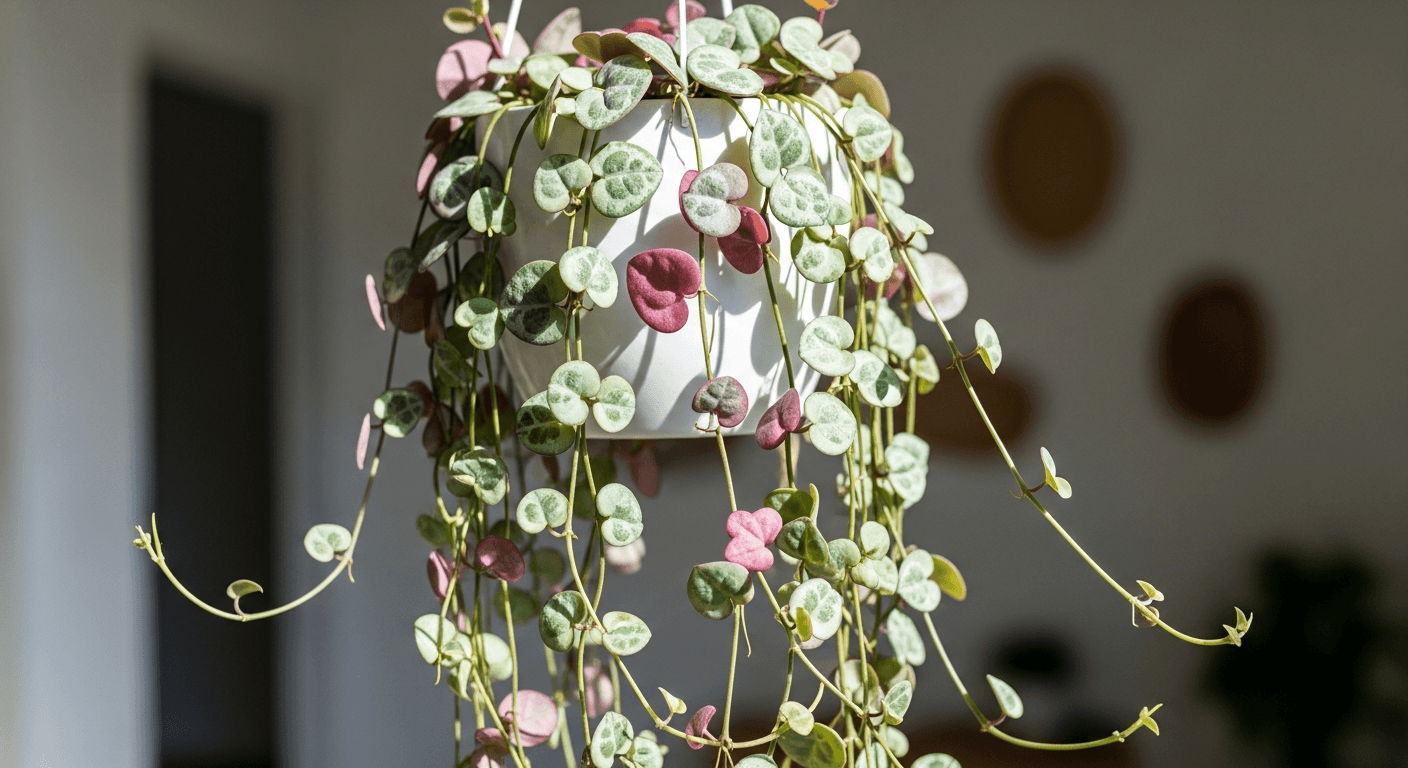
The string of hearts (Ceropegia woodii) is one of the most charming trailing plants out there: long, thin stems studded with tiny heart-shaped leaves marbled in green and silver, with a purple underside. It looks delicate but is surprisingly tough, which makes it a perfect first trailing plant. This guide shows you how to keep yours full and happy.
| Care | Need |
|---|---|
| Light | Very bright indirect |
| Watering | Semi-succulent; dry out almost fully between |
| Soil | Very free-draining (cactus + perlite) |
| Humidity | Normal household air |
| Toxicity | Non-toxic to dogs and cats |
Origin and characteristics
It comes from southern Africa, where it grows among rocks and dangles down hillsides. Its leaves store water, which makes it a semi-succulent: it shrugs off drought and hates overwatering. Over time the stems can grow well past three feet long and, in summer, it produces curious little tubular flowers in mauve-pink shaped like tiny lanterns.
Is your plant looking off and you are not sure why?
Free AI diagnosisBasic care, point by point
Light
Light is the single most important factor for keeping its colors and stopping it from going leggy.
- Ideal: very bright, indirect light next to an east- or west-facing window.
- Tolerates: a little gentle morning sun, which deepens the marbling.
- Avoid: dark corners, where the leaves space out and lose their pattern.
If the stems come out with big gaps between leaves, that's a clear sign of not enough light: move it closer to the window.
Watering
Being semi-succulent, it prefers to stay dry rather than soggy. Water only when the soil is almost completely dry.
- Spring and summer: every 10-14 days, checking the soil first.
- Autumn and winter: very occasionally, almost dormant.
Golden rule: if you're unsure whether to water, wait a few days. Soft, wrinkled leaves want water; yellow, translucent ones warn of overwatering.
Soil and pot
It needs a very free-draining mix. Use a cactus and succulent soil, or add a handful of perlite or coarse sand to all-purpose potting mix. Plant it in a pot with a good drainage hole; small hanging pots suit it perfectly, since it likes to be a little snug at the roots.
Humidity and temperature
Unlike tropical plants, it doesn't need high humidity — normal household air is fine. Keep it above 50 °F and protect it from hard cold and drafts. In summer it enjoys a spell on a balcony in bright shade.
Propagation step by step
It's one of the easiest plants to multiply, and you have several methods:
- Cuttings in water or soil: snip a length of stem with several leaf pairs, strip the lower leaves and bury it or set it in water until it roots.
- Layering onto soil: rest a long stem on another pot of soil; the nodes will root on their own in a few weeks.
- Aerial tubers: those little "beads" that form at the nodes can be buried to sprout new plants.
Planting several cuttings together is the trick to a fuller, bushier plant faster.
It's one of the best hanging plants and its care is almost identical to the string of pearls: both are succulents that want sparse watering and lots of light, and both die of the same thing, too much water.
Common problems
- Long, bare stems: too little light; brighten its spot and pinch the tips to encourage branching.
- Wrinkled leaves: it's thirsty or, paradoxically, the roots are damaged from overwatering. Check the soil.
- Soft, dark base: rot from waterlogging; let it dry out and replant the healthy sections.
- Pests: watch for mealybugs tucked between the leaves. If something looks off, upload a photo to our AI diagnosis tool to identify it.
Is it toxic?
Good news: the string of hearts is considered non-toxic to dogs and cats, so it's a great trailing plant if you have curious pets.
If you love delicate-looking trailing plants, you'll also enjoy the string of pearls, another trailing succulent with very similar care. With good light and careful watering, your string of hearts will form cascading curtains of hearts for years.
Related articles
String of Pearls (Senecio): Care Guide
How to care for string of pearls (Senecio rowleyanus): bright light, careful watering so it doesn't rot, well-draining soil, easy propagation and toxicity.
Tradescantia (Wandering Dude): Care Guide
How to care for tradescantia (zebrina, purple heart): bright light for color, watering, pinching to keep it full, super easy propagation, and toxicity.
Coffee Plant Care: Growing Coffea at Home
Coffee plant (Coffea arabica) care as a houseplant: bright indirect light, humidity, watering, and whether you can really harvest your own coffee beans.
Trouble with your plant?
AI diagnosis