How Often to Dust Houseplant Leaves (and How)
Dust on leaves blocks light and photosynthesis. Learn how to clean each type of plant's leaves without damaging them, and why your plants will grow better.
In this article
- Why it really matters
- How to clean by plant type
- Step-by-step methods
- The damp cloth, your default
- A gentle shower for many-leaved plants
- A dry brush for succulents and fuzzy leaves
- Tips and warnings
- Mistakes that damage the leaf
- Use the chance to inspect the whole plant
- The bonus: rotate the pot
- How often should you clean leaves?
Wipe leaves with a soft cloth and lukewarm water every one to two weeks on large-leaved plants, and use a dry brush on succulents, cacti and fuzzy leaves. This isn't cosmetic: dust blocks light and clogs the stomata, so a thin film cuts photosynthesis exactly where light is already scarce. It's one of those bits of care almost no one does and that make the biggest difference. A layer of dust can be the difference between a plant that thrives and one that stalls for no obvious reason.
Why it really matters
Plants capture light and "breathe" through the leaf surface. A layer of dust:
- Reduces the light reaching the leaf, critical indoors where it's often already short (see the light guide).
- Clogs the stomata, the microscopic pores through which the plant exchanges gases and regulates transpiration.
- Hides early pests like spider mites or mealybugs, which you'd spot while cleaning.
On big, glossy-leaved plants like the rubber plant or the Monstera, dust shows a lot and clearly cuts the light.
Get one plant-care guide a week, no spam.
Subscribe freeHow to clean by plant type
| Leaf type | Method |
|---|---|
| Large and smooth (Monstera, ficus, peace lily) | Damp cloth, supporting the leaf from below |
| Many small leaves (pothos, pilea) | Gentle shower with lukewarm water |
| Succulents and cacti | Soft brush; no pooling water |
| Fuzzy leaves (begonias, violets) | Dry brush; never water on the fuzz |
Step-by-step methods
The damp cloth, your default
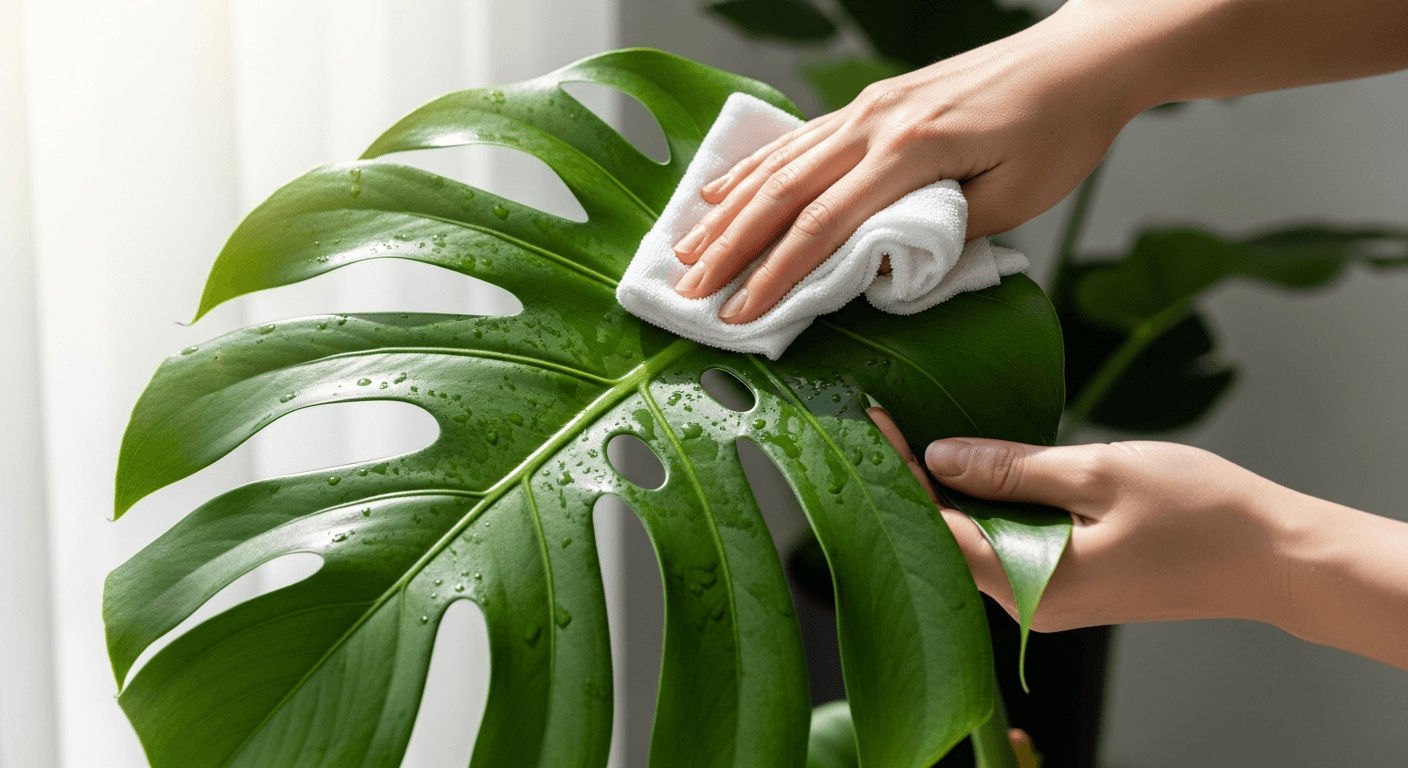
Dampen a soft cloth with lukewarm water, support each leaf from below with one hand, and wipe gently over the top, working from the midrib outwards. Supporting from below is what stops the weight of your hand snapping the petiole. Clean the top and, while you're there, flip it over and check the underside.
A gentle shower for many-leaved plants
For pothos, pileas, ferns and anything with dozens of small leaves, take the plant to the bathroom and give it a low-pressure lukewarm shower: two minutes there removes more dust than twenty with a cloth. Let the pot drain fully before returning it, and never leave the root ball sitting waterlogged.
A dry brush for succulents and fuzzy leaves
On succulents, cacti and velvety leaves, pooling water stains or rots, so you clean them dry. A soft paintbrush — or even a clean makeup brush — lifts dust out of spines and fuzz without leaving a mark.
Tips and warnings
Mistakes that damage the leaf
- Use room-temperature water: cold water spots some leaves (calatheas, violets).
- Skip commercial leaf shines: they look glossy for a moment but clog the leaf's pores. If you want shine, a damp cloth is enough.
- Don't over-wet leaves on fungus-prone plants, and don't leave them soaking in an unventilated corner (see the ambient humidity guide).
Use the chance to inspect the whole plant
With the plant in the sink and every leaf passing through your hand, this is the best look you'll get at it all month: check the undersides and leaf joints, which is where almost all pests start. It's also the perfect moment to prune off dry or yellowing leaves and to notice whether the potting mix smells sour or has gone rock-hard.
The bonus: rotate the pot
While you clean, rotate the pot a quarter turn so the plant grows evenly toward the light instead of leaning to one side. It's a two-for-one: clean leaves and balanced growth.
How often should you clean leaves?
It depends on the environment: in a dusty home or near a busy window, every 1-2 weeks on large-leaved plants. On small plants or in clean spaces, once a month is enough. The practical rule: if you run a finger over a leaf and it leaves a mark, it's time to clean.
Clean leaves = more light = stronger plants. It's one of the bits of care that show the most and get done the least. Plant looking dull despite good care? Try the AI diagnosis tool.
Related articles
How to Prune Houseplants Step by Step
Learn how to prune houseplants: when and where to cut, the right tools to use, pinching for bushier growth and the common mistakes to avoid when pruning.
How to Revive a Dying Plant Step by Step
Your plant is dying and you don't know why. A guide to diagnosing and reviving a dying plant: watering, roots, light, pests and when it is simply too late.
Summer Care for Indoor Plants
Summer houseplant care guide: water more often, shield plants from harsh midday sun, raise humidity, feed during growth and avoid heat stress on hot days.
Trouble with your plant?
AI diagnosis