My Plant Is Dying: What to Do to Save It
Your plant is dying and you don't know why. A guide to diagnosing and reviving a dying plant: watering, roots, light, pests and when it is simply too late.
In this article
- Step 1: diagnose before you act
- Step 2: check the roots
- What to look for when you lift the root ball
- How to cut away rotten roots
- Step 3: fix the watering
- If you were overwatering
- If you were underwatering
- Step 4: adjust light and location
- Step 5: prune only what's beyond saving
- Step 6: be patient and don't "help" too much
- When it's too late
- Rescue a cutting before you bin it
To save a dying plant, work in this order: diagnose before you touch anything, then slide it out of the pot and read the roots, and only afterwards fix the watering, the light and the pruning. Drooping leaves, dull color, mushy stems — when a plant starts fading, the first thing is not to panic or hack everything off in a hurry. Most "dying" plants can still be saved if you find the real cause and act calmly. This guide walks you through that rescue step by step.
Step 1: diagnose before you act
Don't do anything until you know what's wrong. Look at the symptoms and the pattern:
- Yellow, soft leaves, soil always wet → almost always overwatering.
- Wilted, dry, crispy leaves, hard soil → underwatering.
- Soft, dark stems, a rotten smell → possible root rot.
- Spots, webbing or bugs → a pest.
- Long, stretched stems reaching for light → not enough light.
If you're torn between several causes, read the whole pattern before you touch anything: one ugly leaf says almost nothing, but the combination of symptoms does.
Is your plant looking off and you are not sure why?
Free AI diagnosisStep 2: check the roots
The roots tell the truth, and they're the one thing you can't judge from outside the pot.
What to look for when you lift the root ball
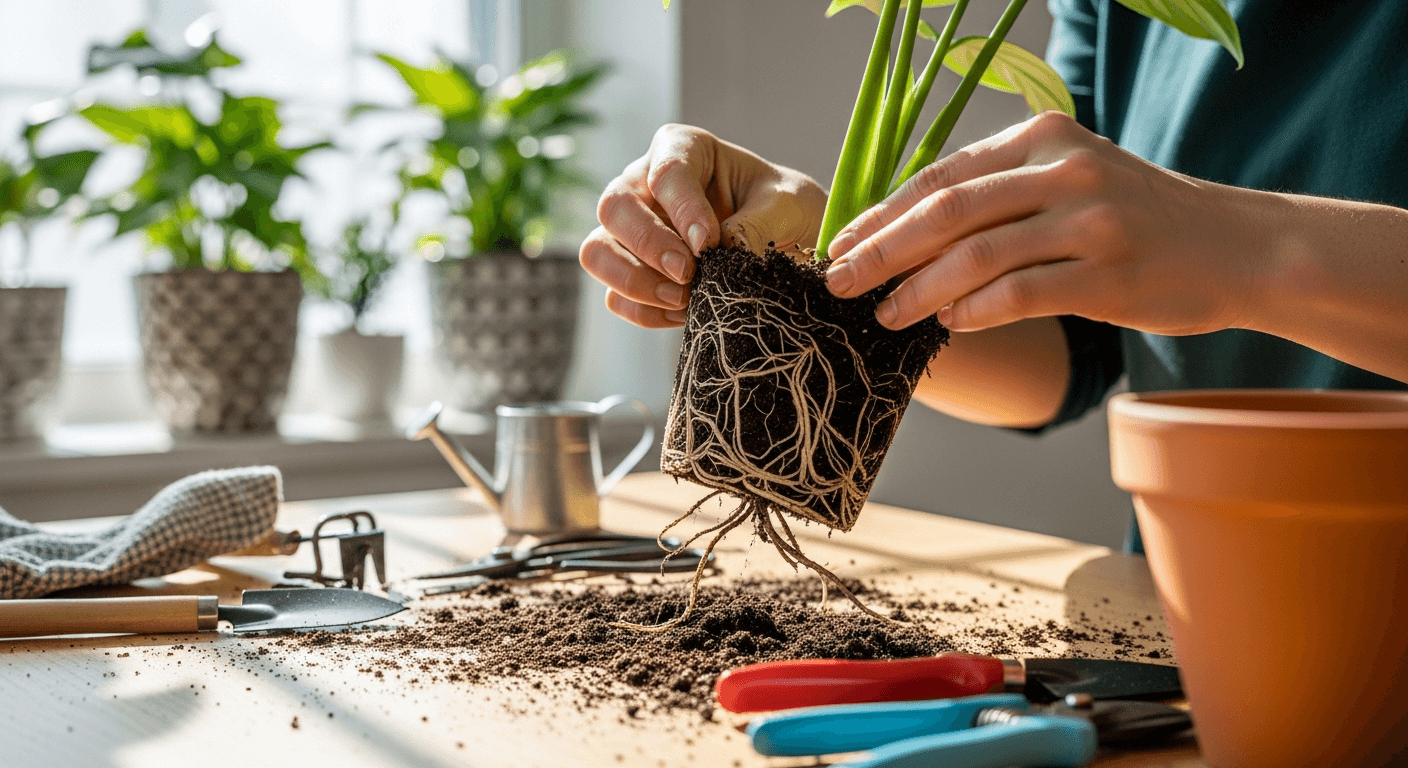
Slide the plant out carefully, holding it by the base of the stem, and loosen the soil a little with your fingers. Firm, white or pale roots mean the plant is alive and the problem lies elsewhere. Brown, mushy roots that smell like a pond are rot, and that needs dealing with the same day.
How to cut away rotten roots
With clean scissors, cut back every damaged root until you reach firm tissue, even if that means removing more than half the root ball. Get rid of the soggy soil too, since it's already colonized, and replant into fresh, airy potting mix in a pot with real drainage. The full procedure is in our guide on root rot.
Step 3: fix the watering
Bad watering is the most common cause of dying plants, and the two directions call for opposite fixes — which is why it pays to know how to tell overwatering from underwatering before you pick up the watering can.
If you were overwatering
Let the soil dry out a few inches before the next watering, never leave water in the saucer, and check with a finger rather than by the calendar. If the mix is still soaked days later, frequency isn't the only issue: either the pot doesn't drain or the soil has compacted.
If you were underwatering
Sit the pot in a basin of water for 15-20 minutes to rehydrate the root ball properly — when soil gets bone dry, water poured on top just runs down the sides and never reaches the middle. Let it drain fully and go back to regular watering.
Step 4: adjust light and location
- A weak plant usually recovers better in bright, indirect light, with no harsh direct sun that would stress it further.
- Move it away from radiators, cold drafts and air conditioning.
- If it was stretched from lack of light, move it toward a window gradually.
Step 5: prune only what's beyond saving
Remove clearly dead leaves and stems (dry, black or rotten) so the plant can focus its energy on what's healthy, cutting just above a node as you would in any houseplant pruning. But don't leave it bare: it needs some leaves to feed itself. If a leaf still has green areas, keep it.
Step 6: be patient and don't "help" too much
A recovering plant needs stability, not more stimulation:
- Don't feed a sick plant: fertilizer on damaged roots burns them.
- Don't repot it again right away if you've already treated it; let it settle.
- Don't water more "just in case": that usually makes things worse.
It's showing improvement when it pushes out a new shoot or a leaf firms up again. That can take anywhere from several weeks to a couple of months.
When it's too late
Sometimes you have to accept the loss. It's very hard to save it if:
- All the roots are rotten and mushy.
- The main stem is hollow, black or falls apart when you touch it.
- There isn't a single living leaf or shoot left.
Rescue a cutting before you bin it
Even so, before it goes in the bin, run your eye over the plant for any stretch of stem that's still firm and green with at least one node. Cut it with clean scissors, strip the leaves off the part that will sit below the surface, and put it in water or damp soil: sometimes a plant "dies" but leaves a piece that grows into a new one — genetically identical, and without the root problems of the original.
Reviving a plant is, above all, about diagnosing well and then doing less, not more: fix the cause, remove the dead, and give it time. More plants are saved with patience than with sudden remedies.
Related articles
Summer Care for Indoor Plants
Summer houseplant care guide: water more often, shield plants from harsh midday sun, raise humidity, feed during growth and avoid heat stress on hot days.
How to Keep Plants Watered While on Holiday
Tricks to keep plants watered while you're away: wicks, water bottles, grouping them in the bathroom, and how to prep your home before you walk out the door.
Winter Care for Indoor Plants
Winter houseplant care guide: water far less, chase the light, keep them away from radiators and drafts, pause feeding and raise the humidity.
Trouble with your plant?
AI diagnosis