How to Choose the Right Potting Mix for Your Plants
The right soil prevents half your problems. Learn which mix to use for succulents, tropicals, orchids and the garden, and the ingredients that improve any soil.
In this article
- What a good potting mix needs
- The 30-second test
- Soil by plant type
- Aroids and big-leaved tropicals
- Succulents, cacti and sun lovers
- Orchids and other epiphytes
- Ingredients that improve any soil
- An easy "good for almost anything" recipe
- Peat or coco coir?
- How often should you refresh the soil?
- Signs it's time to refresh
- If the plant just came home, wait
- Can you reuse old soil?
- Common mistakes
For most green-leaved houseplants the mix that works is 3 parts all-purpose potting soil + 1 part perlite + 1 part coco coir; succulents and cacti want something far more mineral, and orchids go into pine bark with no soil at all. The golden rule behind all of it: garden soil won't do for pots, because it compacts, doesn't drain and suffocates the roots. Soil is the home of the roots, and getting it right prevents half your problems, starting with the dreaded root rot. I see it constantly: people who water well but use the wrong soil and can't understand why their plants rot.
What a good potting mix needs
- Drainage: so excess water runs out fast.
- Aeration: air pockets so the roots can breathe (yes, roots breathe).
- Just-right retention: holds some moisture without waterlogging.
- Nutrients: to feed for a few months (then you'll need to fertilize).
The 30-second test
There's a quick way to tell whether a mix passes: water the pot until it runs out of the bottom and time it. If it takes more than half a minute to start draining, the mix is too dense and short on perlite. Same verdict if the pot still feels like a brick two days after watering.
Get one plant-care guide a week, no spam.
Subscribe freeSoil by plant type
| Plant type | Recommended mix |
|---|---|
| Tropicals (Monstera, pothos, philo) | All-purpose + 20-30% perlite + some coco coir |
| Succulents and cacti | Specific cactus mix (very mineral and free-draining) |
| Orchids | Pine bark (never soil!) |
| Ferns / calatheas | Airy but moisture-retaining (peat/coco + perlite) |
| Garden (tomato, strawberries) | All-purpose rich in compost or castings |
The underlying idea: the more sensitive to excess water a plant is (succulents, cacti), the more mineral and free-draining its soil should be; the more it loves humidity (ferns, calatheas), the more retention.
Aroids and big-leaved tropicals
Monstera, pothos, philodendron and syngonium are climbers from the forest floor: their roots evolved for loose leaf litter, not mud. All-purpose soil with 20-30% perlite and a handful of bark suits them perfectly. If you also train the plant up a moss pole, the aerial roots will find their moisture there instead of demanding it from the soil.
Succulents, cacti and sun lovers
Here the priority isn't feeding, it's drying fast. Half all-purpose soil and half mineral material (perlite, coarse sand or pumice) is the starting ratio. If you live somewhere humid or have a generous hand with the watering can, push the mineral share to 60%.
Orchids and other epiphytes
Phalaenopsis grow clinging to tree bark with their roots in open air. Potting them in soil kills them within months. They belong in medium-grade pine bark, alone or with a little sphagnum moss, and in a clear pot so the roots can photosynthesise too.
Ingredients that improve any soil
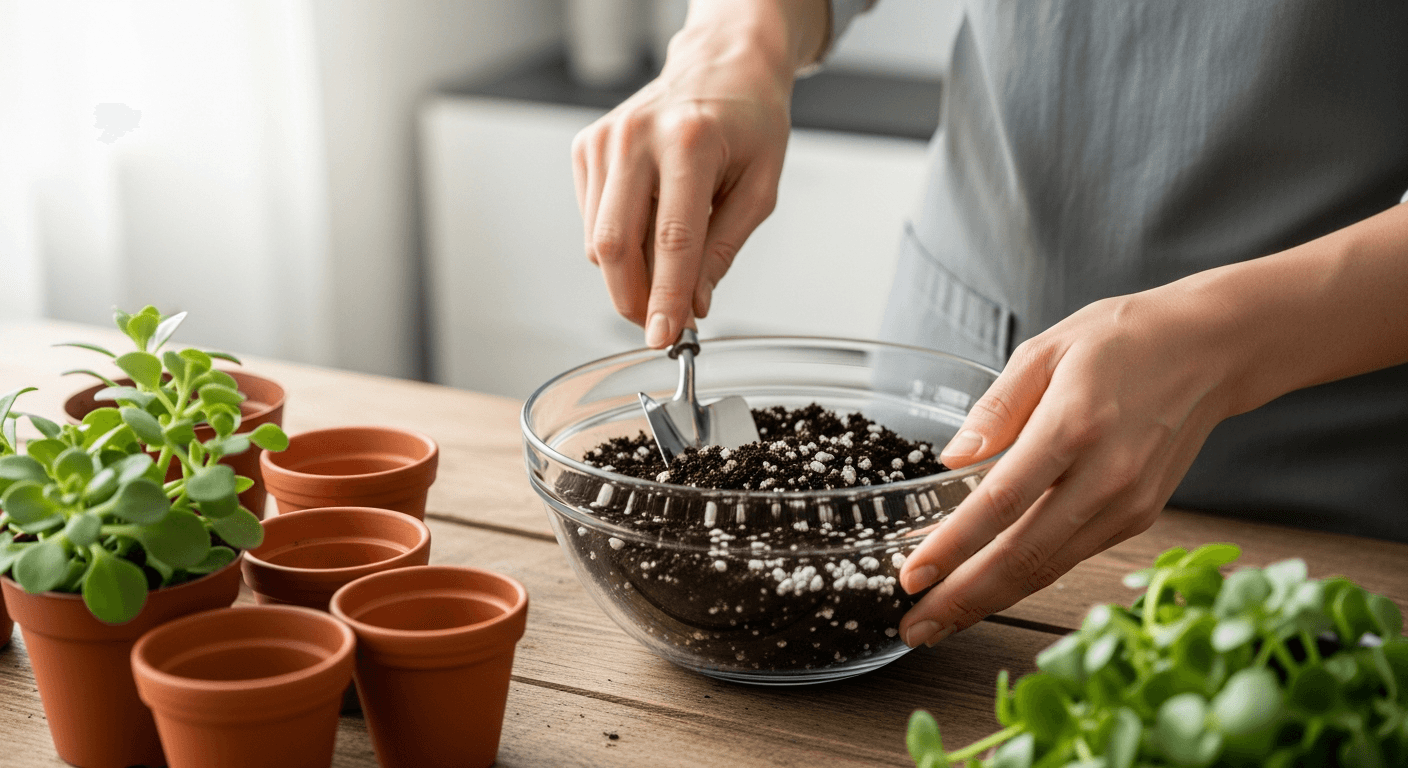
- Perlite: white volcanic beads that aerate and improve drainage. The most useful and cheapest additive; if you add only one thing, make it perlite.
- Coco coir: holds moisture without compacting; a sustainable alternative to peat.
- Compost / worm castings: add nutrients and microbial life to the soil.
- Pine bark: structure and air; ideal for aroids and orchids.
- Coarse sand or pumice: extra drainage for succulents and cacti.
An easy "good for almost anything" recipe
A mix that suits most green-leaved houseplants:
3 parts all-purpose potting soil + 1 part perlite + 1 part coco coir. Airy, drains well and holds just enough moisture.
For succulents, change the ratios: half all-purpose, half perlite/sand.
Peat or coco coir?
Peat holds moisture very well and is cheap, but harvesting it damages ecosystems (peat bogs) and, once dry, it's hard to rehydrate. Coco coir is a more sustainable alternative, with good aeration and easier to re-wet. More and more quality mixes include it; if you can choose, it's a good eco-friendly option.
How often should you refresh the soil?
Soil wears out: it loses structure, compacts and runs out of nutrients. As a rule, refresh it every 1-2 years when repotting (see how to repot a plant).
Signs it's time to refresh
Water runs down the sides and out of the drainage holes without soaking anything; the soil is hard and pulls away from the rim of the pot; roots poke out of the holes or form a tight ball; a whitish crust of mineral salts appears on the surface. Two of those signs and you don't wait for the calendar.
If the plant just came home, wait
Changing the soil the day you buy a plant stacks two stresses at once. Let it settle into your light and your watering rhythm first, following our guide to acclimating a new plant, and repot a few weeks later — unless the soil arrives visibly waterlogged.
Can you reuse old soil?
Yes, as long as it came from a healthy plant. Fluff it up, pull out old roots, and blend it 50/50 with fresh mix, compost and a little perlite. What you should never reuse is soil from a plant that rotted or had a fungal problem: those spores are still alive in there.
Common mistakes
- Using garden soil in pots (it compacts and waterlogs).
- A mix with no perlite: holds too much water.
- Reusing old, spent soil from a plant that rotted (it carries fungi).
- Putting gravel in the bottom "for drainage": it's a myth, it doesn't help and can make it worse. What drains is a good mix + holes in the pot (how to choose a pot).
Get the soil right and watering becomes much easier — half the battle won before you pick up the watering can. Unsure about a plant? Try the AI diagnosis tool.
Related articles
How to Choose the Right Pot for Your Plant
How to choose a pot: why drainage is essential, what size to use (not too big, not too small), and the pros and cons of terracotta, plastic, ceramic and fabric.
How to Prune Houseplants Step by Step
Learn how to prune houseplants: when and where to cut, the right tools to use, pinching for bushier growth and the common mistakes to avoid when pruning.
How to Revive a Dying Plant Step by Step
Your plant is dying and you don't know why. A guide to diagnosing and reviving a dying plant: watering, roots, light, pests and when it is simply too late.
Trouble with your plant?
AI diagnosis