How to Raise Humidity for Your Houseplants
Why your tropical plants get brown tips and how to actually raise ambient humidity. Humidifier, grouping plants, and what does NOT work.
In this article
If your tropical plants have brown tips, the culprit is almost always low ambient humidity (or the chlorine and lime in tap water). Most tropicals want around 60% humidity and a heated home sits below 30%, so the things that actually fix it are a humidifier near them, grouping them together or a pebble tray — misting barely moves the needle. Many houseplants come from humid jungles and struggle in the dry air of our homes. I learned this the hard way fighting with a calathea until I realized the problem wasn't the watering, but the air.
Which plants need humidity
| Need | Ideal humidity | Examples |
|---|---|---|
| High | 60% or more | Calatheas, ferns, marantas, fittonia, alocasias |
| Medium | 40-50% | Monstera, pothos, philodendron, peace lily |
| Low | They get too much | Succulents, cacti, snake plant |
In winter with heating, home humidity can drop below 30% — far too dry for tropicals (and a paradise for spider mites). That's the same stretch of the year when it pays to revisit winter care for indoor plants, because watering and light shift too.
Is your plant looking off and you are not sure why?
Free AI diagnosisWhat DOES work
A humidifier makes the biggest difference
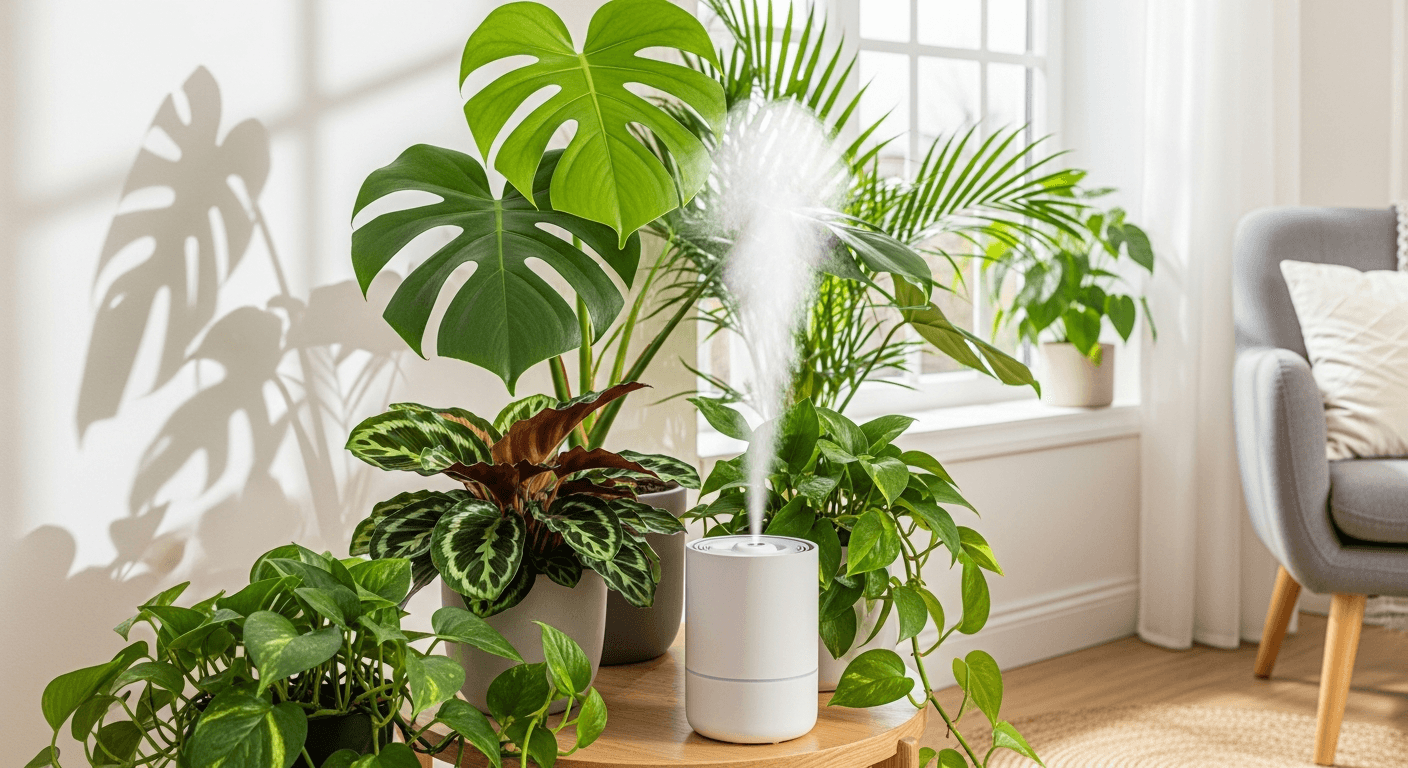
It's the most effective, consistent option because it holds the level steady around the clock instead of nudging it for a moment. Place it three to five feet from the demanding plants, never blowing straight onto the leaves. If you keep several tropicals together, a small 2-3 litre unit covers a room and is the best money you can spend on them.
Building a microclimate without gadgets
- Grouping plants: together they create a more humid microclimate, because they transpire and share that moisture.
- Pebble tray with water: the pot sits on top (not touching the water); as it evaporates, local humidity rises. Useful for a single plant.
- Humid rooms: a bathroom or kitchen with light is ideal for calatheas and ferns.
What does NOT work (or barely)
- Misting the leaves: it raises humidity for only a few minutes and, done wrong, leaves droplets that encourage fungus and spots. It's no substitute for a humidifier. It's the most widespread myth.
- Putting the pot inside a saucer of water: that's not humidity, it's waterlogging (and it rots the roots).
The other culprit: water
When humidity is already fine and the tips keep browning, the problem is usually in the watering can, not in the air.
Telling low humidity apart from hard water
Low humidity dries out the whole leaf: it goes dull, curls at the edges and loses firmness across the entire surface. Hard water instead marks only the tips and edges, leaving a crisp, sharply defined brown border while the rest of the leaf stays green and firm. If you're unsure, measure with a hygrometer before you change your water.
What water to use for sensitive plants
Chlorine and lime from the tap build up in the potting mix and eventually scorch the leaf tips. Let water sit for 24 hours in an open jug (chlorine evaporates), or switch to filtered or rainwater if you live in a hard-water area. This matters most for calatheas, marantas and ferns — a snake plant won't even notice.
How to measure it
A cheap hygrometer tells you the real humidity in each spot of the house. You'll be surprised how dry the air is near a radiator (sometimes below 25%). Measuring helps you place each plant where it suits rather than guessing.
So is misting useless?
It has a minor role: it freshens the leaf for a moment and can help dislodge spider-mite webbing. For dust, wiping the leaves with a damp cloth works far better and leaves the leaf breathing properly. But as a way to maintain ambient humidity it's ineffective, because the effect lasts minutes. If your goal is genuinely to raise humidity, go straight to a humidifier or grouping plants.
Raise the humidity where it's needed and the brown tips will disappear. Plant with ugly tips? Try the AI diagnosis tool or review why leaves turn yellow and get leaf spots.
Related articles
Winter Care for Indoor Plants
Winter houseplant care guide: water far less, chase the light, keep them away from radiators and drafts, pause feeding and raise the humidity.
Alocasia (Elephant Ear): Care Guide
How to care for alocasia (elephant ear, Polly): bright indirect light, consistent watering, high humidity, winter dormancy, pests, and toxicity to pets.
How to Prune Houseplants Step by Step
Learn how to prune houseplants: when and where to cut, the right tools to use, pinching for bushier growth and the common mistakes to avoid when pruning.
Trouble with your plant?
AI diagnosis