LED Grow Lights: When You Need One and How to Position It
LED grow light guide: when you actually need one, what full spectrum means, how far away and how many hours to run it, and how to choose for your plant.
In this article
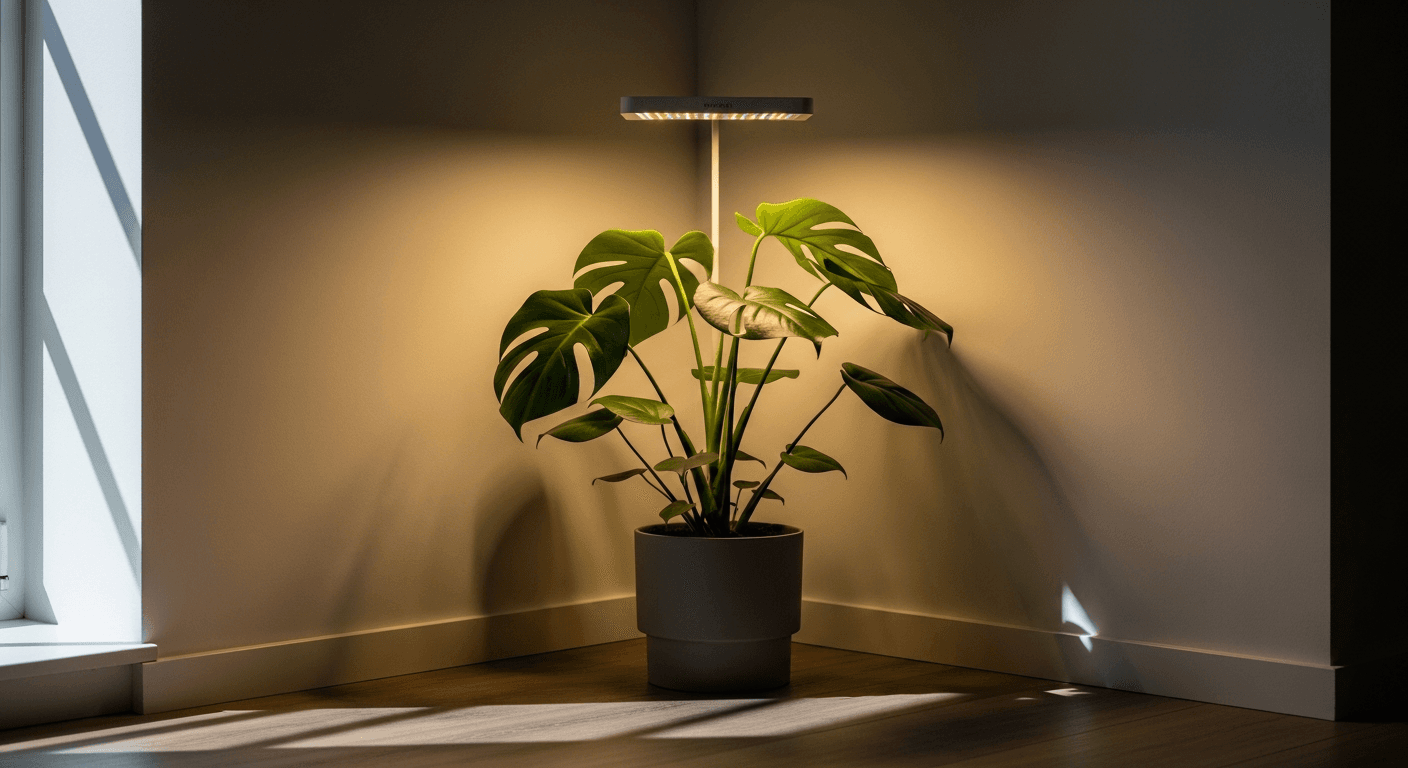
If your home is dark, you have a windowless corner, or you want to start seeds in winter, an LED grow light can genuinely change what's possible indoors. I learned this the hard way: I lost a calathea and a pile of leggy seedlings to a north- facing apartment before I accepted that some plants simply weren't getting enough photons, no matter how often I watered or fed them. The good news is that grow lights have gotten cheap, efficient, and easy to live with. The bad news is that there's a lot of myth and marketing noise around them. This guide cuts through it: when you actually need one, what the terms mean, and exactly how to set it up so your plants thrive instead of bleaching or stretching.
Do you need a grow light?
Not every plant needs one, and buying a lamp you don't need is a common first mistake. Consider one if:
- Your home gets little natural light and plants stretch toward the window — long, weak stems with small, widely spaced leaves. This is etiolation, and it's the clearest signal a plant is light-starved. If that's your situation, the full picture is in our guide to leggy plants.
- You want to start seeds or cuttings in winter, when daylight is short and weak. Seedlings under a dim windowsill turn pale and floppy within a week.
- You keep demanding plants (calatheas, fruiting vegetables, herbs) in an interior spot far from a window.
- Your usable window faces north (in the northern hemisphere) or is blocked by a building, an awning, or a tree.
If your plants grow healthy and compact with the light they already have, you don't need a lamp at all. Before you buy anything, it's worth understanding how much light your space really delivers — our guide to indoor plant light explains how to read a room by season and aspect. And sometimes the smarter fix is a different plant, not a device: check which low-light plants can handle the spot you've got.
Is your plant looking off and you are not sure why?
Free AI diagnosisWhat the key terms mean
Grow-light packaging is full of jargon designed to sound impressive. Here are the only terms that actually affect your buying decision.
Full spectrum
Look for full-spectrum bulbs or panels. They emit across the wavelengths plants use — roughly 400–700 nm, the band horticulturists call PAR (photosynthetically active radiation) — and they look like normal white light, so they're pleasant to live with. For nearly every home grower, full spectrum is the simplest and most versatile choice. You don't need to obsess over precise red-to- blue ratios; that's a commercial-greenhouse concern, not a living-room one.
Color temperature (kelvin)
- 5000–6500 K (cool / daylight): crisp, bluish-white light that favors compact leafy growth and is ideal for seedlings.
- 2700–3500 K (warm): softer, more golden light that nudges flowering and fruiting in plants ready to bloom.
- A good full-spectrum light usually blends both, which is why a single panel can carry a leafy plant and a flowering one.
PPFD, PAR, and "wattage"
Two specs tell you how much usable light a lamp delivers:
- PAR is the slice of the spectrum plants can photosynthesize with.
- PPFD (photosynthetic photon flux density, in µmol/m²/s) measures how many of those photons land on the leaf at a given distance. It's the number that actually matters, and it drops off fast as you move the light away.
Ignore the marketing "equivalent wattage" on the box. A cheap panel can claim "1000 W" while drawing 60 watts from the wall and delivering mediocre PPFD. If a listing gives a real PPFD at a stated distance, that's a far more honest signal of quality.
Why LED
LEDs sip power, barely heat up (so they won't scorch nearby leaves), and last for years — typically 25,000–50,000 hours. Forget old incandescent bulbs: they waste most of their energy as heat rather than useful light, and they'll cook a leaf that drifts too close.
Distance and hours: what matters most
This is where the majority of people go wrong, and it's the single biggest lever you control.
- Distance: for typical home LED bulbs and bars, place the light about 8–16 inches (20–40 cm) from the canopy. Too close bleaches and burns; too far does effectively nothing because PPFD collapses with distance. Higher-power panels may want to sit farther back — follow the maker's chart if it gives one.
- Hours (the photoperiod): run it 10–14 hours a day, never 24. Plants need a daily dark period to regulate respiration and their internal clock; light around the clock stresses many species and can actually slow growth.
- Use a timer or smart plug. This is non-negotiable for consistency. Set it once and you'll never forget to switch the light on or off again.
More hours is not better. Without a genuine dark period each night, a lot of houseplants get stressed, and flowering plants may refuse to set buds.
A simple rule of thumb for hours by goal:
| Plant or stage | Daily light (hours) | Color temperature |
|---|---|---|
| Foliage houseplants (maintenance) | 10–12 | 4000–6500 K |
| Seedlings and cuttings | 14–16 | 6500 K |
| Herbs (basil, parsley, cilantro) | 12–14 | full spectrum |
| Flowering / fruiting plants | 12–14 | full spectrum, warmer bias |
Seedlings are the exception that wants the longest day — up to 16 hours — because you're trying to bank as much energy as possible into stocky, sturdy growth before transplanting.
How to choose by goal
| Goal | What to look for |
|---|---|
| Maintain houseplants | Full-spectrum LED bulb in a normal lamp or clip light |
| Seedlings and cuttings | LED panel or bar at 6500 K suspended over the tray |
| Herbs on a counter | Adjustable bar or hoop light you can raise as they grow |
| Fruiting / flowering plants | Powerful full-spectrum panel, placed closer |
| A single decorative corner | Adjustable LED grow spotlight or stylish bulb |
For most readers keeping pothos, philodendrons, or a calathea alive in a dim room, a single full-spectrum bulb in an existing lamp is plenty. You only need a proper panel when you're growing something demanding or covering a whole tray of seed cells. If you're raising food indoors, the same principles power our guides to herbs in pots and microgreens, where steady light is the difference between stocky harvests and pale, floppy stems.
Reading the signs: is the light working?
Your plant tells you everything if you watch it over two to three weeks. Adjust distance and hours based on its reaction — there is no universal magic number, and the same lamp behaves differently on a small succulent versus a thirsty monstera.
| Symptom | Likely cause | Fix |
|---|---|---|
| New growth is compact, deep green, short internodes | Light is correct | Leave it; don't tinker |
| Pale, bleached, or yellow-white patches on top leaves | Too much / too close | Raise the light 4–6 in or cut an hour or two |
| Crispy brown leaf edges nearest the lamp | Light burn (rare with LED, but possible) | Increase distance immediately |
| Plant keeps stretching and leaning toward the lamp | Not enough light | Lower the light or extend hours |
| Long gaps between leaves, weak stems | Still light-starved | More intensity, not just more hours |
| Leaves curl down and look tired by evening | Photoperiod too long | Reduce to 10–12 hours |
Etiolated, stretched growth and bleached growth are the two opposite failure modes, and people confuse them constantly. Stretching means too little light — the plant is reaching. Bleaching means too much — the chlorophyll is getting overwhelmed. Treat them oppositely.
Common mistakes
- Buying an intense purple "blurple" light because it looks high-tech. White full-spectrum performs just as well for the home, and it's far nicer to live under — purple light makes it impossible to spot pests or color changes on your plants.
- Leaving it on day and night. Plants are not solar panels; they need the dark.
- Placing it too far away "to avoid burning" and then wondering why nothing changed. With LEDs, light burn is rare; under-lighting from excess distance is the far more common problem.
- Forgetting the timer. Inconsistent schedules confuse a plant's rhythm as much as no light at all.
- Expecting a lamp to fix a watering or root problem. Light won't save a plant that's actually drowning, so rule that out first.
Cost, placement, and winter
One of the real perks of LEDs is how little power they draw. A household grow bulb or bar typically pulls 10–30 watts — less than many small appliances — so running it 12 hours a day barely registers on your electricity bill. Even a modest panel running all winter usually costs a few dollars a month.
Placement matters more than power. Light follows the inverse-square law, meaning intensity drops off steeply with distance: a plant directly under the lamp gets dramatically more than one set even 12 inches off to the side. To light several plants well, cluster them under a single bulb or spread the output across a long bar rather than relying on one narrow spotlight. Aim the brightest center of the beam at your neediest plant.
Grow lights truly earn their keep in the cold months, when the sun is low and the days are short. They pair naturally with the rest of your seasonal routine — winter plant care covers how to adjust watering and feeding so the extra light actually translates into healthy growth rather than weak, leggy winter stems.
A good full-spectrum LED, at the right distance and on a timer, turns any dark corner into a place where plants thrive. If your plant looks off and you're not sure whether it's a light problem or something else entirely — a pest, root rot, or a nutrient issue — snap a photo and run it through our AI diagnosis. It will help you tell etiolation apart from the look-alikes before you spend money on a lamp you may not need.
Related articles
Fast-Growing Houseplants (Rewarding Results Fast)
The best fast-growing houseplants: pothos, tradescantia, spider plant and philodendron. How to speed up growth with light, feeding and timely repotting.
The Best Plants for the Kitchen (and Where to Put Them)
The best plants for the kitchen: easy herbs plus houseplants that tolerate humidity and low light. What to avoid near heat and how to care for them here.
Self-Watering Pots: How They Work and When to Use Them
How self-watering pots work (the reservoir and wicking), which plants love them and which hate them, and how to use them right without rotting the roots.
Trouble with your plant?
AI diagnosis