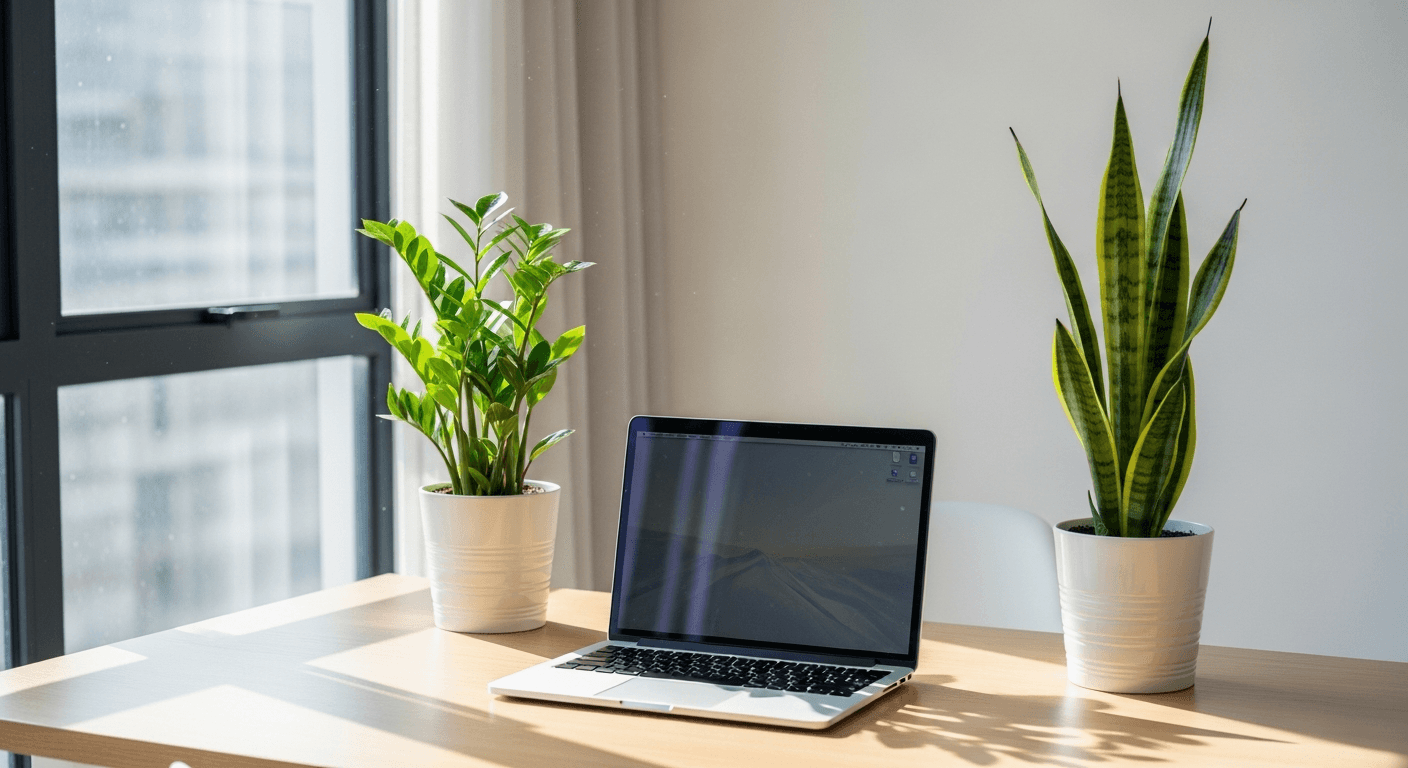
Desk Plants That Survive Air Conditioning and Neglect
The best office plants: tough, low-light and low-maintenance picks for your desk, ideal for when you are away every weekend and short on time to care.
In this article
- Why the office is hard on plants
- How to read your desk's light first
- The best office plants
- 1. ZZ plant (Zamioculcas zamiifolia)
- 2. Snake plant (Dracaena trifasciata, formerly Sansevieria)
- 3. Pothos (Epipremnum aureum)
- 4. Aglaonema (Chinese evergreen)
- 5. Spider plant (Chlorophytum comosum)
- 6. Parlor palm (Chamaedorea elegans)
- 7. Cacti and succulents
- Quick comparison
- Plants for windowless desks
- The office watering trick
- Symptom to cause to fix
- Extra tips that keep a desk plant thriving
- Plants to avoid in the office
- A simple plan to start
A plant on your desk does more than it seems: it adds a little green, softens a hard-edged room and gives your eyes somewhere to rest between screens. But let me be honest with you, because I learned this the hard way: the office is a brutal place for a houseplant. Patchy light, air conditioning that runs all night, weekends with nobody around, and a busy human who forgets it exists by Wednesday. I killed a couple of pretty ferns at my first desk job before I understood that the trick isn't a green thumb, it's choosing plants that genuinely forgive neglect. Pick the right one and it will outlast endless meetings without complaint.
This guide covers exactly which plants thrive at a desk, how to match them to your light, how to water on an office schedule, and how to spot trouble before it spreads.
Why the office is hard on plants
Before we get to the winners, it helps to understand what you are up against. An office combines several stresses that rarely line up at home:
- Uneven, weak light. Many desks sit several metres from a window and run mostly on overhead fluorescents or LEDs. Plant leaves use far less of that light than your eyes assume.
- Dry air. Central heating and air conditioning strip moisture from the room, pushing humidity down toward 30 percent or lower, well below the 40 to 60 percent most tropical plants prefer.
- Erratic watering. The classic office pattern is nothing all week, then a guilty flood on Monday. That swing is harder on roots than a steady routine.
- Temperature swings and cold drafts. The room can be warm at 3 p.m. and chilly by morning, and a vent blowing straight onto the leaves makes it worse.
- Tight space and dust. A small pot on a cluttered desk, with a film of dust slowly coating the leaves and blocking what little light arrives.
So we prioritise plants that are tough, drought-tolerant, and genuinely happy in low to medium light.
Is your plant looking off and you are not sure why?
Free AI diagnosisHow to read your desk's light first
The single most useful thing you can do is be honest about your light, because it decides everything else. Here is a quick field test that needs no app: at midday, hold your hand about 30 cm above the spot where the pot will sit and look at the shadow it casts.
- Sharp, crisp shadow with hard edges: bright light. You can grow almost anything, including succulents and cacti.
- Soft, fuzzy shadow you can clearly see: medium light. Pothos, spider plant and most of this list will be happy.
- Barely a shadow at all: low light. Stick to a ZZ plant, snake plant or pothos, and consider a small grow light.
A north-facing window or a desk two to three metres back from any window is usually medium-to-low. Overhead office lighting alone, with no window nearby, is low. If you want the full breakdown of how plants actually use light indoors, our guide to reading indoor light walks through it room by room.
The best office plants
1. ZZ plant (Zamioculcas zamiifolia)
The undisputed queen of the office. Those glossy, dark green leaves grow from fat underground rhizomes that store water like a camel, so it shrugs off two or three weeks of forgetfulness without blinking. It tolerates plain fluorescent light and dry air, and it grows slowly enough that it never outgrows a desk. Water only when the top half of the pot is bone dry; the one way to actually kill it is to keep the soil wet. Mildly toxic if chewed, so keep it away from desk-grazing pets.
2. Snake plant (Dracaena trifasciata, formerly Sansevieria)
Compact, upright and almost indestructible. Its stiff sword-like leaves store water, so it copes with low light and long gaps between drinks. It is perfect for a desk corner or windowsill where space is tight, and a single plant takes up almost no footprint. As a bonus it keeps doing its slow business overnight, releasing oxygen rather than absorbing it. Water roughly every two to three weeks, less in winter.
3. Pothos (Epipremnum aureum)
If you want something that trails or climbs, this is your plant. It grows in medium and even fairly low light, tolerates the odd missed watering, and is the easiest thing in the world to propagate, just snip below a node and root the cutting in a glass of water on your desk. Train it up a small support or let it spill off a shelf. The golden and jade varieties hold their colour in lower light better than the heavily variegated ones, which need brighter spots to stay vivid.
4. Aglaonema (Chinese evergreen)
An underrated office champion with broad, patterned leaves in green, silver, even pink. The green-and-silver types are remarkably low-light tolerant, and the plant generally prefers to dry out a little between waterings, which suits a forget-prone owner perfectly. It is one of the few genuinely decorative foliage plants that handles office conditions without sulking. For the full rundown, see our aglaonema care guide.
5. Spider plant (Chlorophytum comosum)
Tough, fast and cheerful. It tolerates a wide range of light, forgives the odd dry spell, and is non-toxic, which makes it a safe pick for a shared space. The arching leaves and the little trailing plantlets, the so-called babies, make it one of the most decorative options here, and each baby roots easily into its own pot to gift a colleague.
6. Parlor palm (Chamaedorea elegans)
When you want a softer, more tropical look without the fuss of a true palm, this is the one. It was a Victorian parlour favourite precisely because it copes with dim indoor light, and it stays a manageable size for years. Keep the soil lightly moist rather than soggy and it brings a gentle green texture that breaks up a wall of monitors. More detail in our parlor palm guide.
7. Cacti and succulents
For a desk right beside a bright window these are ideal: small, sculptural and needing barely any water. The catch is light. Away from a window they stretch, pale and lose their tight shape, a problem worth understanding before you commit, which we cover in the guide to leggy, stretched plants. If your desk is dim, skip these and choose from the foliage plants above.
Quick comparison
Use this to match a plant to your actual conditions rather than the conditions you wish you had.
| Plant | Light needed | Watering | Drought tolerance | Pet-safe? |
|---|---|---|---|---|
| ZZ plant | Low to bright | Every 2 to 3 weeks | Very high | No |
| Snake plant | Low to bright | Every 2 to 3 weeks | Very high | No |
| Pothos | Low to medium | Weekly-ish | Medium-high | No |
| Aglaonema | Low to medium | When top is dry | Medium | No |
| Spider plant | Medium | Weekly-ish | Medium | Yes |
| Parlor palm | Low to medium | Keep lightly moist | Low-medium | Yes |
| Cacti / succulents | Bright only | Every 2 to 4 weeks | Very high | Mostly yes |
Plants for windowless desks
If your desk sits deep in an interior space with only artificial light, play it safe with a ZZ plant, snake plant, pothos or a silvery aglaonema, which are the four that genuinely cope. You will find more contenders in our guide to low-light plants.
If the area is truly dark, a small LED grow light changes the game entirely. You do not need anything industrial. A compact clip-on or a slim bar light running for eight to ten hours on a cheap plug-in timer, set roughly to your working hours, is plenty to keep a desk plant healthy and growing rather than merely surviving. Position it 20 to 40 cm above the foliage and you will see the difference within a few weeks.
The office watering trick
The biggest killer of office plants is not drought, it is the irregular rhythm: nothing all week, then a huge soak on Monday out of guilt. Roots hate that swing. A calmer approach works far better.
- Water thoroughly, then leave it alone. When the soil has dried to the depth your plant wants, water until it runs from the drainage holes, then empty the saucer after ten minutes so the roots are not left sitting in water. One proper drink beats a daily splash.
- Check before you pour, every time. Push a finger two to three centimetres into the soil. Damp means wait. Dry means water. This one habit prevents most office plant deaths, because overwatering and underwatering produce confusingly similar droopy, yellowing leaves, which we untangle in the overwatering vs underwatering guide.
- Plan for the weekend. For most of the plants here, a thorough Friday watering easily covers two days off. Before a long weekend or holiday, group the pots together away from direct sun to slow evaporation, and use the tricks in our watering while away guide.
- Consider self-watering. If you travel often or simply know yourself, a self-watering pot acts as a buffer, drawing up moisture from a reservoir as the plant needs it. Our guide to self-watering pots explains which plants suit them and which do not.
A reliable rule for a typical heated, air-conditioned office: water the thirsty plants like pothos and spider plant about once a week, and the tanks like ZZ and snake plant every two to three weeks. Cut both back in winter, when growth slows and the soil stays wet longer.
Symptom to cause to fix
When something looks off, resist the urge to water more. Match the symptom to the likely cause first.
| Symptom | Likely cause | Fix |
|---|---|---|
| Lower leaves yellow, soil stays wet | Overwatering | Let it dry out fully; check drainage; empty the saucer |
| Crispy brown leaf tips | Dry air or under-watering | Move away from the vent; water on schedule; group plants |
| Long, pale, leaning growth | Too little light | Move toward the window or add a grow light |
| Pale, dusty, dull leaves | Dust blocking light | Wipe leaves with a damp cloth |
| Tiny webs or sticky residue | Spider mites or other pests | Isolate, rinse the leaves, treat early |
| Sudden leaf drop after a cold snap | Cold draft or AC | Relocate away from the vent |
Extra tips that keep a desk plant thriving
- Turn the pot a quarter turn each week so it grows evenly toward the light instead of leaning hard at the window and going lopsided.
- Dust the leaves. Office air leaves a surprising film, and dust on a leaf is a curtain over a solar panel. A quick wipe every couple of weeks helps; see cleaning leaves the right way.
- Keep it off the vent. Cold, dry air blasting the foliage causes crispy edges and stress faster than almost anything else.
- Always use a pot with drainage and tip out the saucer, because standing water is the express lane to root rot.
- Give dry-air sufferers a little help. Most plants here do not need it, but if you keep a fussier plant, a pebble tray or grouping pots together raises local humidity. More on that in our humidity guide.
Plants to avoid in the office
Not everything belongs on a work desk. From experience, I would skip:
- Heavy droppers that shed leaves, petals or pollen onto your keyboard and papers.
- Humidity divas such as delicate ferns and, sadly, calatheas. The dry office air punishes them, and you will spend more time troubleshooting than enjoying them.
- Fast or large growers that outgrow a desk in a single season and demand constant pruning.
- Toxic plants in shared spaces, especially if colleagues take cuttings home to households with curious pets or small children. When in doubt, lean toward the non-toxic spider plant or parlor palm.
A simple plan to start
If you only remember one thing: match the plant to your light, then water on a finger-check rhythm. For a dim interior desk, buy a ZZ plant or snake plant and water it every two to three weeks. For a desk with a soft shadow at midday, a pothos or aglaonema will look great and ask for little. For a bright windowsill, a small succulent. Add a five dollar timer-controlled grow light if your spot is genuinely dark, and you have a plant that will sail through air conditioning, late nights and lonely weekends.
Is your office plant yellowing, drooping or just looking off and you cannot work out why? Snap a clear photo of the leaves and soil and run it through our AI plant diagnosis. It is exactly how I now catch trouble early, before a fixable problem becomes a dead plant.
With a ZZ or a snake plant on your desk, you get a green touch that survives endless meetings, relentless air conditioning and the quietest of weekends, no green thumb required.
Related articles
The Best Plants for the Bedroom
The best plants for the bedroom: easy, low-light tolerant and low-maintenance species for a healthier, calmer and more relaxing room you will truly love.
The Best Bathroom Plants (With or Without a Window)
Which plants thrive in a bathroom using the shower's humidity, which tolerate low light, and which to avoid with no window. A list with basic care tips.
The Best Plants for Low-Light Indoor Spaces
Got a dark flat or a room with no sun? These plants thrive in low light. A list with their care and the tricks to keep them alive where others die.
Trouble with your plant?
AI diagnosis