Which Plants Belong in a Bedroom (and the Night-Time Myth)
The best plants for the bedroom: easy, low-light tolerant and low-maintenance species for a healthier, calmer and more relaxing room you will truly love.
In this article
- Do bedroom plants make you unhealthy?
- What to look for in a bedroom plant
- Our favorite bedroom plants
- 1. Snake plant (Sansevieria / Dracaena trifasciata)
- 2. Pothos (Epipremnum aureum)
- 3. ZZ plant (Zamioculcas zamiifolia)
- 4. Peace lily (Spathiphyllum)
- 5. Spider plant (Chlorophytum comosum)
- 6. Areca palm (Dypsis lutescens)
- 7. Calathea, ferns and friends for an en-suite bathroom
- Light, water and safety at a glance
- Be honest about your light
- If you have pets, choose safe plants
- How to make them shine in the bedroom
- Common bedroom plant mistakes
- Troubleshooting at a glance
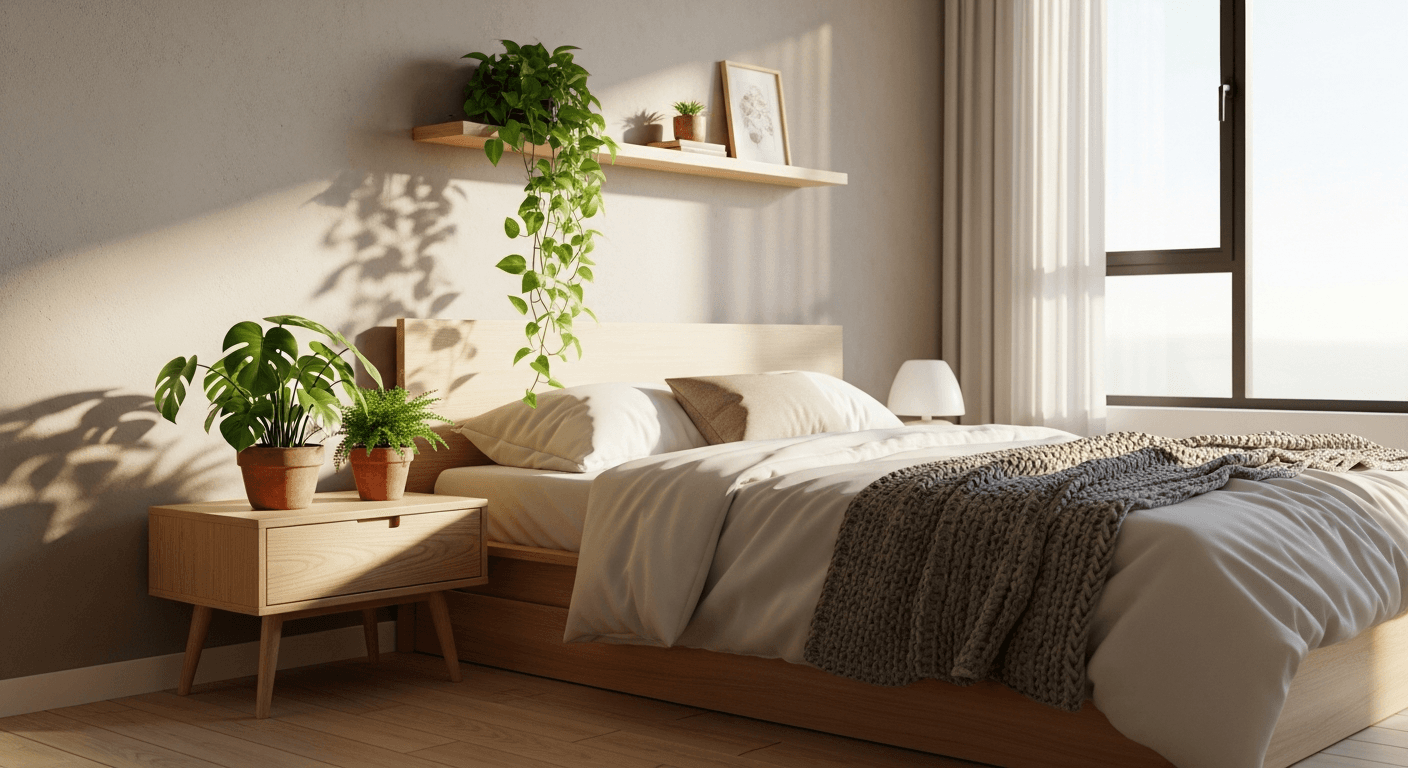
The bedroom is one of the best rooms in the house to live with plants. They soften a space that is usually all flat surfaces and fabric, they pull your shoulders down a notch at the end of the day, and the right ones ask almost nothing of you in return. The catch is that bedrooms are tricky on two fronts: the light is usually lower than the living room, and you are not in there much during the day to notice when something starts to go wrong. I learned that the slow way, losing a fern on a north-facing nightstand before I understood what its crispy edges were telling me. So this guide is about choosing plants that genuinely thrive in those conditions, plus exactly how to keep them happy.
Do bedroom plants make you unhealthy?
It is a stubborn myth, so let me settle it first. At night most plants switch from photosynthesis to plain respiration and release a small amount of CO2, the same as you and I do. But the quantities are tiny. A single sleeping adult exhales vastly more CO2 over eight hours than a roomful of pothos ever could, and your bedroom is not airtight. There is zero health risk to sleeping next to plants, and plenty of quiet upside in how the room feels.
You may have heard that certain species "clean the air" while you sleep. Be a little skeptical of the dramatic version of that claim. The famous studies were run in sealed laboratory chambers, and the real-world effect of a few houseplants on indoor air quality is modest at best. Keep plants in the bedroom because they look beautiful and calm you down, not because you expect them to replace a window or an air purifier.
Is your plant looking off and you are not sure why?
Free AI diagnosisWhat to look for in a bedroom plant
Before we get to specific species, here is the short checklist I run through. A good bedroom plant ticks most of these boxes:
- Low-light tolerance. Bedrooms often have one smaller window, blackout curtains, or a blind you keep half-down. The plant needs to cope with less light than a sunny living room offers.
- Drought forgiveness. You want something that shrugs off a missed watering, because the bedroom is exactly where you forget.
- Low mess. Heavy leaf drop, shedding flowers, or pollen on the nightstand gets old fast.
- Clean watering habits. Damp soil that sits too long invites fungus gnats, and nobody wants a cloud of them by the bed.
- Pet and child safety, if that applies to you. Several classic bedroom plants are toxic if chewed. I flag every one below.
Our favorite bedroom plants
Each of these has earned its place in a real bedroom. I have grouped them roughly from toughest to slightly fussier.
1. Snake plant (Sansevieria / Dracaena trifasciata)
Almost indestructible, and my first recommendation for nervous beginners. It handles genuinely low light, stores water in its thick upright leaves so it tolerates long gaps between drinks, and its sculptural shape looks elegant in any corner. Water it only when the soil is fully dry, which in a dim room might mean every three to four weeks, and even less in winter. The classic way to kill one is kindness, so err dry. Full details live in our snake plant guide. Note: mildly toxic to cats and dogs if eaten.
2. Pothos (Epipremnum aureum)
The easiest trailing plant in the world. It lives happily in medium or low light, forgives neglect, and looks lovely cascading from a shelf or the top of a wardrobe above the bed. It grows fast, tells you it is thirsty by going slightly limp, and roots in a glass of water with almost no effort, so one plant quickly becomes three. See the full pothos care guide for the variegated types and trailing tips. Toxic to pets if chewed.
3. ZZ plant (Zamioculcas zamiifolia)
Glossy, deep green, almost plastic-perfect leaves, paired with serious tolerance for shade and drought. It stores water in fat underground rhizomes, so it genuinely wants to be left alone, which makes it the perfect plant for the dim bedroom corner that light barely reaches. Water roughly every two to three weeks, less in winter. Our ZZ plant guide covers the dramatic black-leaved Raven variety too. Toxic if ingested.
4. Peace lily (Spathiphyllum)
The drama queen of the group, in the best way. It tolerates low light and, on top of that, throws up elegant white spathes that read as flowers. Best of all for a forgetful owner, it droops its whole body when thirsty and springs back within hours of a drink, so it tells you exactly what it needs. Keep it out of harsh direct sun and water when the top inch of soil dries. The full peace lily guide has bloom-coaxing tips. Important: toxic to cats and dogs.
5. Spider plant (Chlorophytum comosum)
If you share the bed with a pet, start here. The spider plant is non-toxic, tolerant of lower light, and produces dangling baby plantlets that look charming from a high shelf or a hanging pot. It is thirstier than the succulents above, so keep the soil lightly moist, and brown leaf tips usually mean dry air or fluoride in tap water rather than anything serious. See the spider plant guide for propagation, which is almost too easy.
6. Areca palm (Dypsis lutescens)
For a soft, leafy, tropical presence in a corner, and another pet-safe pick. The areca palm prefers bright indirect light, so it suits a bedroom with a decent window rather than a cave, but it brings height and movement that the stiffer plants cannot. Keep it evenly moist and give it some humidity. More in the areca palm guide.
7. Calathea, ferns and friends for an en-suite bathroom
If your bedroom opens onto a bathroom with even a little light, that humid microclimate is a gift. Humidity lovers that sulk in a dry bedroom thrive there: a Boston fern trailing from a shelf, or a calathea with its painted, prayer-folding leaves. Calatheas in particular are far happier in steamy bathroom air than on a dry nightstand, so let the room do the work for you.
Light, water and safety at a glance
Here is the quick comparison I wish someone had handed me when I started. "Low light" means a few feet back from a north window or beside a curtained one; "bright indirect" means within a few feet of a window that does not get scorching midday sun.
| Plant | Light | Water (typical) | Pet-safe? |
|---|---|---|---|
| Snake plant | Low to bright indirect | Every 3-4 weeks | No |
| Pothos | Low to medium | When top 2 in dry | No |
| ZZ plant | Low to medium | Every 2-3 weeks | No |
| Peace lily | Low to medium | When it droops / top 1 in dry | No |
| Spider plant | Medium, indirect | Keep lightly moist | Yes |
| Areca palm | Bright indirect | Keep evenly moist | Yes |
| Boston fern | Medium, indirect | Keep moist, loves humidity | Yes |
| Calathea | Medium, indirect | Keep lightly moist | Yes |
Be honest about your light
This is where most bedroom plants quietly fail, so do not skip it. Rooms are almost always darker than our eyes tell us, because our pupils adjust and fool us. Before you buy anything, watch the room over a full day. Which direction does the window face? North-facing rooms get soft, weak light all day; east gets gentle morning sun; west gets strong afternoon light; south gets the most. Then factor in how often the blind is actually down.
A genuinely useful trick is the shadow test. On a bright midday, hold your hand a foot above the spot where the plant will live. A crisp-edged shadow means decent light, a soft fuzzy shadow means medium, and barely any shadow at all means low light, where only the snake plant, ZZ and pothos will truly cope. If you want to go deeper on reading a room, our guide to understanding indoor plant light walks through every exposure, and the full low-light plants roundup lists everything that survives the dimmest corners.
If your bedroom is a genuine cave with no usable daylight, do not force a doomed plant through a slow death. Either accept that you have a low-light-only room, or add a small grow light on a timer. A modest LED grow bulb running a few hours a day transforms what you can keep, and on a timer it never becomes a chore. The same logic applies at the desk; our office plants guide tackles the windowless-room problem in detail.
If you have pets, choose safe plants
This matters more in the bedroom than anywhere, because that is where a cat curls up at 3 a.m. and a dog noses around the nightstand. Snake plant, peace lily, pothos and ZZ are all toxic if chewed, usually causing mouth irritation, drooling and stomach upset rather than anything catastrophic, but unpleasant and avoidable. If your animal sleeps with you, lean on the safe options above: spider plant, areca palm, Boston fern, calathea and parlor palm are all non-toxic. Otherwise, place the toxic ones genuinely out of reach, remembering that cats climb and a trailing pothos is basically a dangling toy. The full vetted list lives in our pet-safe plants guide.
How to make them shine in the bedroom
Choosing well is half the job; styling and placement is the other half. A few habits make a real difference:
- Group in odd numbers. Cluster three plants of different heights on a nightstand or dresser. Odd-numbered groupings look intentional rather than scattered, and a tight cluster also raises local humidity a little.
- Build in layers. Put a tall plant on the floor, a trailing one up high on a shelf or wardrobe, and a small one on the bedside table. The vertical range is what makes a corner feel lush instead of sparse. For ideas up top, see our best hanging plants guide, and for floor-standing statement plants, best large indoor plants.
- Keep the leaves clean. Dust is not just cosmetic; a film of it blocks the already-scarce light a bedroom plant depends on. Wipe broad leaves with a damp cloth every few weeks, as covered in our guide to cleaning leaves.
- Rotate a quarter turn weekly. Plants lean toward the window. A small turn each time you change the sheets keeps them growing evenly instead of sprawling sideways.
Common bedroom plant mistakes
Most bedroom plant trouble comes down to a handful of avoidable habits. Watch for these:
- Overwatering in low light. This is the big one. In a dim room, soil dries far more slowly than in a bright one, so the watering schedule that worked in the living room will drown the same plant in the bedroom. Always check that the soil is actually dry before you water. If you are unsure which way your plant is suffering, our overwatering vs underwatering guide shows how to tell the two apart, because they can look maddeningly similar.
- Fungus gnats from soggy soil. Those tiny black flies that drift up when you move the pot breed in constantly wet topsoil, and they are especially annoying beside a bed. The cure is to let the top inch or two dry out between waterings and to ditch any standing water in the saucer. See the fungus gnats guide for traps and longer-term fixes.
- A plant that needs more light than the room offers. A fiddle-leaf fig or a calathea on a dark nightstand will decline no matter how perfectly you water. Match the plant to the light, not the other way around.
- Ignoring dry winter air. Bedroom heating in winter can drop humidity sharply, which crisps the leaf edges of ferns and calatheas. A simple pebble tray or a small humidifier helps; our humidity for plants guide has the practical options.
Troubleshooting at a glance
When a bedroom plant starts looking off, run through this quick symptom map before you panic or, worse, water it again.
| Symptom | Likely cause | What to do |
|---|---|---|
| Yellowing lower leaves, soggy soil | Overwatering | Let it dry fully; check drainage |
| Crispy brown leaf tips | Dry air or fluoride in water | Raise humidity; use filtered water |
| Tall, sparse, leaning growth | Too little light | Move closer to the window or add a grow light |
| Pale, washed-out new leaves | Too little light or hungry | Brighten the spot; feed in growing season |
| Tiny flies hovering at the pot | Fungus gnats in wet soil | Dry the topsoil; set sticky traps |
| Sudden droop, dry soil | Underwatering (peace lily, fern) | Water thoroughly; it should recover |
Most bedroom plant problems trace back to that overwatering-in-low-light trap, so when in doubt, wait and feel the soil rather than reaching for the watering can.
If one of your bedroom plants looks off and the table above does not pin it down, snap a clear photo of the affected leaves and run it through our AI plant diagnosis. It is the fastest way to catch a pest or a watering problem early, while it is still easy to reverse, which after losing a few plants of my own is exactly the habit I wish I had built sooner.
With two or three tough, well-matched plants and a watering can you reach for a little less often than feels natural, your bedroom gains freshness, calm and a bit of life, without becoming one more thing on the to-do list.
Related articles
How to Make a Terrarium Step by Step (Open or Closed)
Learn how to build a terrarium step by step: the container, drainage layers, which plants to use (fittonia, moss, ferns) and how to care for it afterward.
The Best Trailing and Hanging Indoor Plants
The best hanging indoor plants: pothos, string of hearts, ivy, spider plant and more, with quick care notes to fill your shelves with cascading green.
The Best Large Indoor Plants for a Corner
The best large indoor plants to fill a corner: bird of paradise, fiddle leaf fig, Monstera, kentia and more, with their real light needs and care notes.
Trouble with your plant?
AI diagnosis